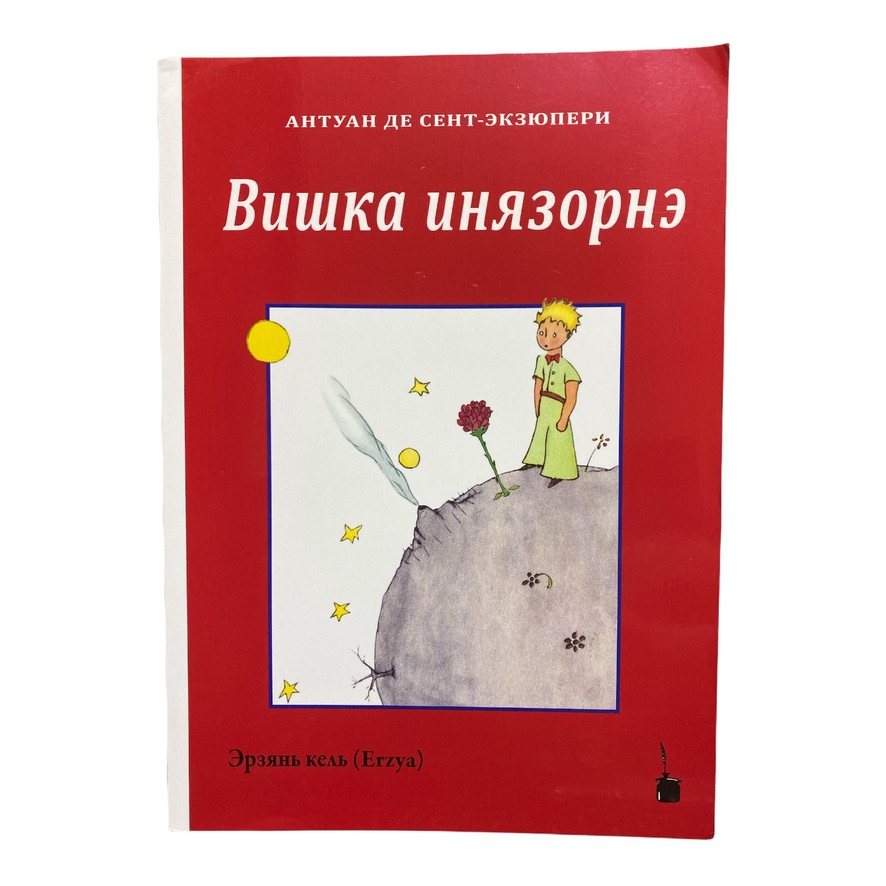
Вишка Инязорнэ / Vishka Inäzorne — in Erzya language.
Erzya (эрзянь кель, Erzjanj kel) belongs to the Mordvinic branch of the Uralic family, standing alongside its sister tongue Moksha as one of the two literary languages of the Republic of Mordovia in Russia’s Volga heartland, and reaching further afield in kinship to the Mari languages and, more distantly still, to Finnish and Estonian across the wider Finno Ugric world. Though outsiders have long lumped Erzya and Moksha speakers together under the single Russian exonym Mordva, the two peoples have always thought of themselves as distinct, occupying different parts of Mordovia, the Erzya traditionally settled towards the north and east, and speaking languages different enough from one another that mutual understanding is often far from automatic.
That sense of a distinct Erzya identity runs through the culture as much as the language. It survives strikingly in the modern epic Mastorava, a twentieth century compilation of ancient Erzya and Moksha oral poetry and myth assembled in deliberate echo of Finland’s own national epic the Kalevala, gathering scattered songs of the earth goddess Mastorava herself into a single unifying narrative for a people who had never before possessed one written text of their own. That same pride found a memorable individual expression in the celebrated sculptor Stepan Nefyodov, who adopted the name Erzya as his professional identity, carrying his people’s name onto gallery walls across Europe and South America and turning an ethnonym into an artistic signature.
Erzya also preserves, alongside its Mari cousins further north along the Volga, a living memory of pre Christian belief, with reverence still paid in places to Ineshkipaz and other spirits of the old Erzya pantheon even after centuries of Orthodox Christian influence. Linguistically it remains close enough to Moksha that the two are sometimes still popularly conflated, yet distinct enough to require separate grammars, dictionaries and schooling, a duality that mirrors, in its own Volga setting, the same delicate balance between kinship and independence found among the Mari to the north, all threads within the same broad and resilient Uralic tapestry.