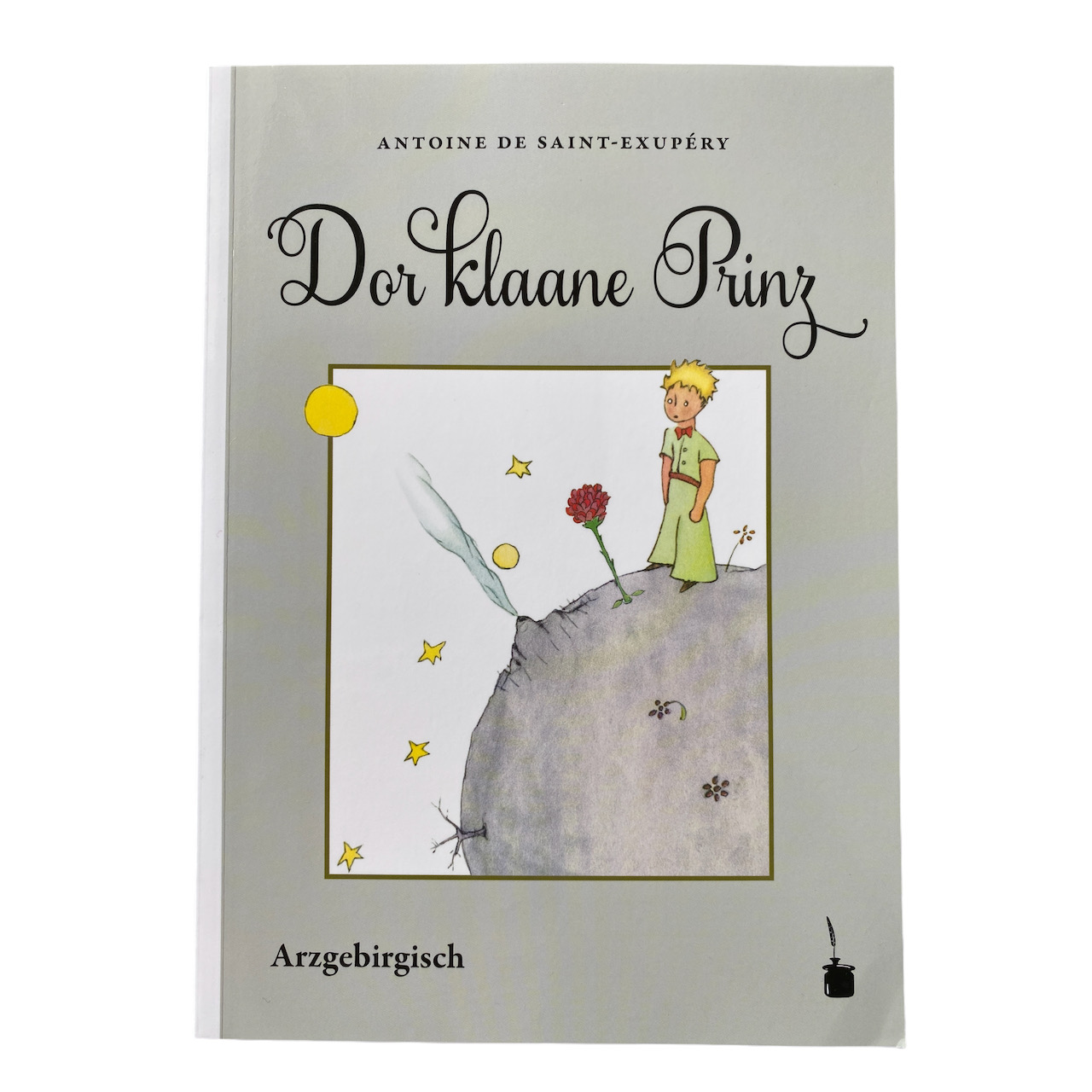
Dor Klaane Prinz — in Erzgebirgisch dialect of Central German.
The Ore Mountains dialect (Erzgebirgisch) belongs to Upper Saxon (Obersächsisch), part of the East Central German family, and is spoken across the Ore Mountains (Erzgebirge), a range straddling the modern border between Saxony in Germany and Bohemia in the Czech Republic. Its very name points to what shaped it most: Erz means ore, and this was, for centuries, one of the richest mining regions in Europe, a history that left the dialect with a distinctive, strongly sing song intonation and a vocabulary still threaded through with specialised mining terms, the everyday inheritance of communities whose working lives once ran, quite literally, underground.
That mining history began in earnest in 1168, when the discovery of silver near Freiberg touched off one of medieval Europe’s great mining booms, drawing settlers, wealth, and technical innovation into the mountains for centuries afterwards, a legacy significant enough that the entire cross border mining region was inscribed as a UNESCO World Heritage Site in 2019, jointly recognised by Germany and the Czech Republic for more than eight hundred years of continuous mining activity. Few people realise quite how far that legacy travelled: silver mined at Joachimsthal in these same mountains was struck into large coins from 1520 onward, known as Joachimsthaler and soon shortened simply to Thaler, a name that spread across Europe as the generic word for a large silver coin and eventually crossed the Atlantic to become, through American usage, the English word dollar, meaning the world’s most consequential currency name has its quiet linguistic roots in this one small dialect speaking corner of the Ore Mountains.
As the mining boom gradually faded in later centuries, many local miners turned to woodcarving to supplement their income during the long winter months, and it is this very dialect region that gave the world the nutcracker (Nussknacker), the incense smoking figure (Räuchermännchen), the revolving Christmas pyramid (Weihnachtspyramide), and the candle lit arch (Schwibbogen), shaped to resemble a mine entrance and lit to welcome miners home from the darkness below, all now instantly recognisable fixtures of Christmas markets worldwide, even though almost none of their admirers connect them back to this particular strip of Saxon German.