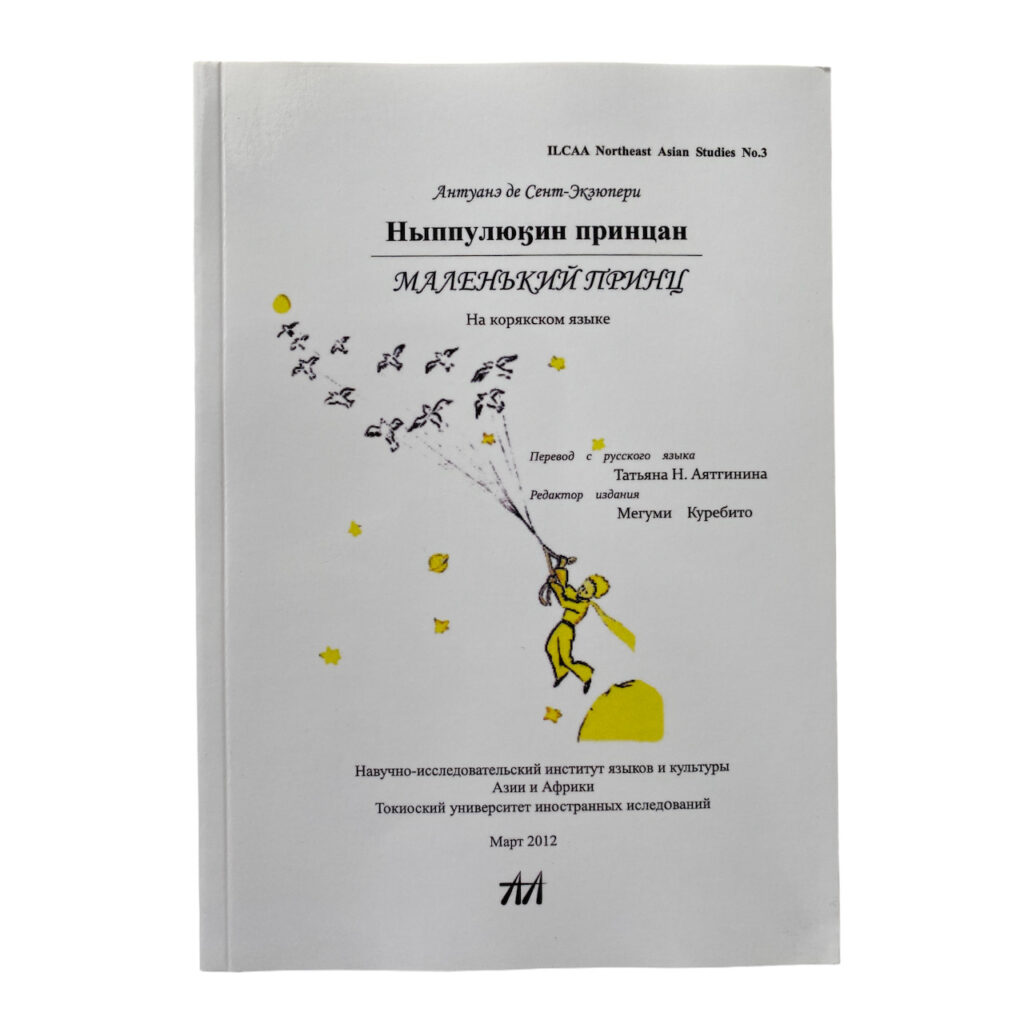
Ныппулюӄин Принцан / Nyppulyuqin Printsan — in Koryak language.
Koryak (self name нымылан, nymylan, roughly the settled ones, alongside чавчыв, chavchyv, rich in reindeer, used by the herding communities for themselves) belongs to the Chukotko Kamchatkan family, in the Chukotkan branch beside its closest relative Chukchi, whose own speakers call themselves Луоравэтлан, Luoravetlan, the genuine people. Itelmen, spoken further south on Kamchatka, forms the family’s separate and more distant Kamchatkan branch. The family as a whole remains a linguistic isolate, with no securely proven kin anywhere else on earth despite various speculative proposals.
Koryak life split between inland reindeer herders and coastal hunters of sea mammals, held together by patrilineal kinship rather than any centralised authority, and by a shamanic religion presided over by the trickster raven Кутх, Kutkh, a figure echoed closely in Chukchi and Itelmen myth and, intriguingly, in the Raven cycles of the Tlingit, Haida and Tsimshian across the Bering Strait. Russian annexation in the late seventeenth century found some thirteen thousand Koryak, a number roughly halved by resistance, Chukchi raiding and smallpox before the century’s end; Soviet collectivisation then forced reindeer into state farms and families into fixed settlements, a rupture that, alongside Russian medium boarding schools, badly weakened the language’s transmission.
Grammatically Koryak is polysynthetic and agglutinative, building whole objects and modifiers into single verbs through pervasive incorporation, and organises its case system on an ergative absolutive basis it shares with Chukchi, governed further by a dominant recessive vowel harmony in which one strong vowel forces every other vowel in the word to shift and match it. Written, where it is written at all, in a Cyrillic alphabet extended with letters such as Ӄ and Ӈ, it survives across five dialects but is spoken today by barely one in five ethnic Koryak, some 1,665 of roughly 7,500. It shares its stretch of tundra with Tungusic speaking Even herders, the isolate Yukaghir, and Eskimo Aleut speaking Yupik along the coast, an extraordinary compression of unrelated tongues now converging, like so many of its neighbours, under the shared pressure of Russian.